A HEPA air purifier significantly improves indoor air quality by capturing at least 99.97% of airborne particles as small as 0.3 microns, including allergens, dust, mold spores, and many viruses. This high-efficiency filtration is achieved through a dense maze of fibers that trap particles via interception, impaction, and diffusion, making every breath cleaner and healthier for occupants.
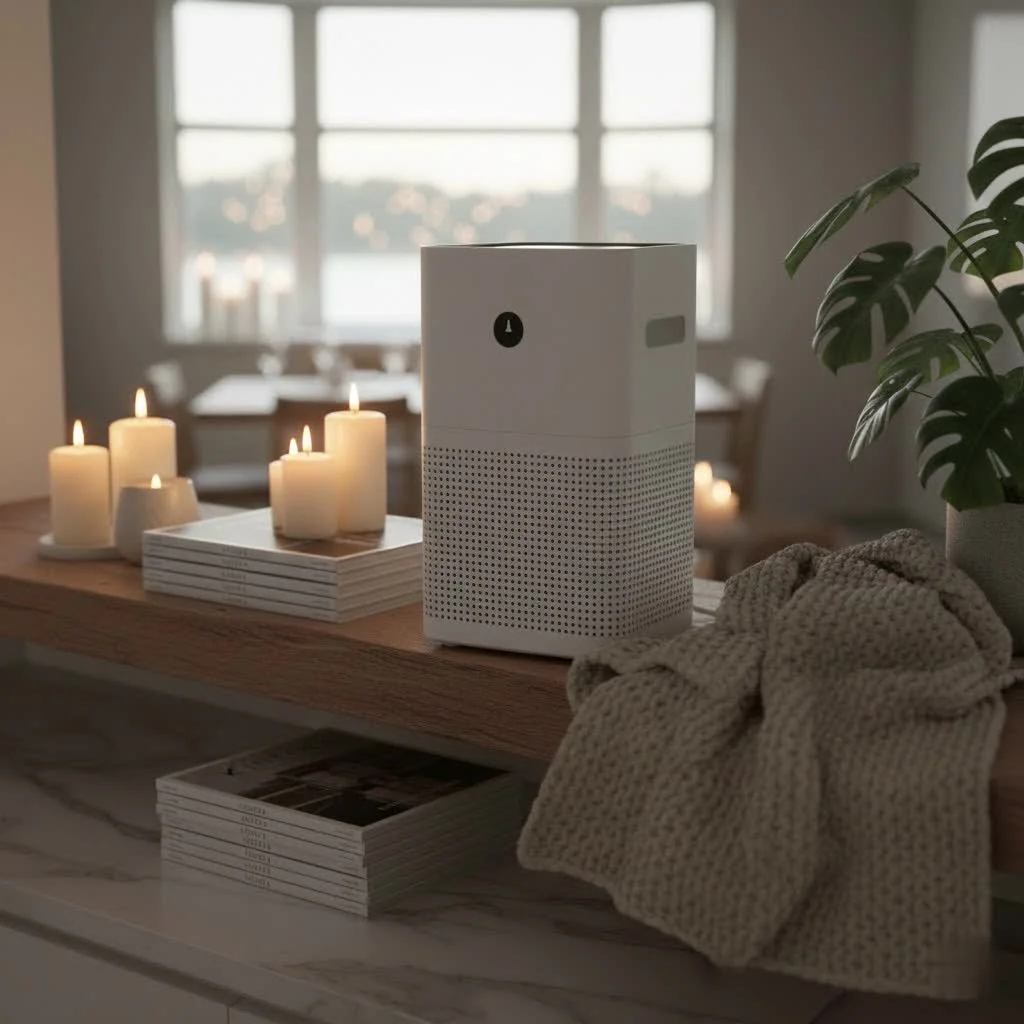 air purifier operating in a clean, modern living room” style=”margin: 20px auto;width: 800px;max-width: 100%;height: auto” />
What Exactly is a HEPA Filter and How Does it Work?
At its core, HEPA stands for High-Efficiency Particulate Air. This refers to a dense, intricate maze of randomly arranged fibers, typically made of fiberglass or polypropylene. Unlike a simple sieve that just blocks large particles, HEPA filters are engineering marvels that trap particles through three ingenious mechanisms:
- Interception: Larger particles, like dust and pollen, simply stick to a fiber as they pass by.
- Impaction: Medium-sized particles, unable to navigate around the winding fibers, directly collide and embed themselves within the filter material.
- Diffusion: This is where the magic happens for the tiniest particles, including many viruses and ultrafine particulate matter. These microscopic particles (<0.1 microns) move erratically due to collisions with gas molecules (a phenomenon known as Brownian motion), increasing their chances of hitting and getting trapped by a fiber.
The widely recognized standard for a True HEPA filter is its ability to capture at least 99.97% of airborne particles that are 0.3 microns in diameter. Why 0.3 microns? Because this specific size is considered the “Most Penetrating Particle Size” (MPPS) – the most challenging for filters to capture. Interestingly, HEPA filters are actually even more efficient at capturing particles both larger and smaller than 0.3 microns, offering comprehensive protection.
Many modern HEPA air purifiers also feature a multi-stage filtration system, often starting with a washable pre-filter to catch larger debris like pet hair and lint, followed by an activated carbon filter to tackle odors and gases, before the air finally passes through the crucial True HEPA filter.
True HEPA vs. “HEPA-Type”: What You Need to Know
This distinction is perhaps one of the most critical when choosing an air purifier. The term “HEPA” has become a buzzword, but not all filters are created equal.
A True HEPA filter is rigorously tested and certified to meet the stringent efficiency standard: capturing 99.97% of particles as small as 0.3 microns. This certification is typically based on standards set by bodies like the U.S. Department of Energy (DOE) or European EN1822 (where H13 and H14 filters are considered medical-grade True HEPA). When a filter carries the “True HEPA” label, you can trust its performance.
However, you’ll often encounter terms like “HEPA-type,” “HEPA-like,” or “HEPA-style” filters. These are marketing terms, not certifications. While they may offer some level of filtration, they often fall short of the 99.97% benchmark, perhaps only capturing 99% or primarily targeting larger particles. For anyone dealing with allergies, asthma, or seeking genuinely improved air quality, a True HEPA filter is an absolute necessity. Don’t compromise on this vital detail.
The Game-Changing Benefits of a HEPA Air Purifier for Your Home
Integrating a HEPA air purifier into your home isn’t just about cleaner surfaces; it’s about fundamentally improving your living environment and well-being. The benefits extend far beyond simply moving air around.
- Improved Respiratory Health: For allergy sufferers, a HEPA air purifier is a lifeline. It effectively removes common airborne allergens like pollen, dust mites, and pet dander, significantly reducing symptoms such as sneezing, congestion, and itchy eyes. Similarly, individuals with asthma find immense relief as cleaner air means fewer triggers for attacks, potentially leading to better symptom management.
- Reduced Airborne Pollutants: Our homes are surprisingly polluted, often more so than outdoor air. HEPA air purifiers excel at trapping a vast array of indoor pollutants, including dust, mold spores, bacteria, and even many viruses. This is especially crucial in today’s world, where understanding airborne pathogen transmission is key.
- Odor and VOC Reduction: While the HEPA filter focuses on particulates, many HEPA air purifiers come equipped with an activated carbon filter. This powerful combination neutralizes unpleasant odors from cooking, pets, and smoke, and absorbs volatile organic compounds (VOCs) emitted by paints, cleaning products, and furniture.
- Enhanced Overall Well-being: Breathing clean air has a profound impact on your daily life. It can lead to better sleep quality, increased focus, and a stronger immune system, allowing your body to spend less energy fighting off irritants.
“Using a True HEPA air purifier is one of the most proactive steps you can take to safeguard your family’s respiratory health, creating a sanctuary of clean air indoors,” says Dr. Anya Sharma, leading air quality researcher.
Choosing the Right HEPA Air Purifier: Your Smart Buying Guide
Selecting the perfect HEPA air purifier can seem daunting with so many options available. Here’s what you should consider to make an informed decision:
Room Size and CADR (Clean Air Delivery Rate)
|
Our Picks for the Best Air Purifier in 2026
As an Amazon Associate I earn from qualifying purchases.
|
||
| Num | Product | Action |
|---|---|---|
| 1 | Air Purifiers for Bedroom with H14 True HEPA, Quiet Air Cleaner With Sleep Mode Night Light, Small Air Purifier Covers Up to 1200ft², 360° Air Intake, 3 Speeds, Timer, Aroma Function, Black |

|
| 2 | LEVOIT Air Purifier for Home Large Room Up to 1073Ft² with Air Quality Monitor, AHAM VERIFIDE, Smart WiFi, Washable Pre-Filter, HEPA Sleep Mode for Pets, Allergies, Dust, Pollen, Vital 100S-P, White |
|
| 3 | KNKA Air Purifier for Home Bedroom Large Room Up to 3,500 Ft², HEPA Air Cleaner with Washable Pre-Filter, AHAM VERIFIDE, AQI Display, ECO Mode, Pet Mode for Pets, Allergies, Dust, Pollen, APH4000 |
|
| 4 | Air Purifiers for Home Large Room up to 2200sq.ft with Washable Filters, EVALIT Air Purifiers for Bedroom with Fragrance, PM 2.5 Display Air Quality Sensor for Smoke Dust Odors, White, 1Pack+3Modes |
|
| 5 | LEVOIT Air Purifiers for Home Large Room Up to 1875 Ft² with Washable Pre-Filter, AHAM VERIFIDE, Air Quality Monitor, HEPA Sleep Mode for Allergies, Pet Hair in Bedroom, Vital 200S-P, White |
|
| 6 | LEVOIT Air Purifier for Home Allergies Pet Hair in Bedroom, Covers Up to 1073 ft² by 56W High Torque Motor, AHAM VERIFIDE, 3-in-1 Filter with HEPA Sleep Mode, Remove Dust Smoke Odor, Core300-P, White |
|
| 7 | ECOSELF Smart Air Purifier for Home Large Rooms, with WiFi Control, Covers Up to 2400 Ft², Smart Mode, AQI Display, 22dB Sleep Mode & Aromatherapy with 2X-Power Filtration, HAP603WF, White |
|
| 8 | LEVOIT Air Purifiers for Bedroom Home Dorm, AHAM VERIFIED, 3-in-1 Filter Claener with Fragrance Sponge, Portable Filters Smoke, Allergens, Pet Dander, Odor, Dust, Office, Desktop, Core Mini-P, White |
|
| 9 | Air Purifiers for Home Large Room, Cover Up to 2400 Ft² with True HEPA Filter, Smart Mode, PM2.5 Air Quality Display, 22dB Sleep Mode, Aromatherapy with 2X-Purification & 360°Air Outlet, HAP603, White |
|
| 10 | Air Purifiers for Home Large Room Cover Up to 1500 Ft² with True HEPA Filter, 20dB Sleep Mode, 360° Air Intake & Outlet, Air Cleaner for Bedroom Pets, 7 Color Light, HAP604, Bright White |
|
This is paramount. An air purifier too small for your space won’t be effective. Look for two key metrics:
- CADR (Clean Air Delivery Rate): Developed by the Association of Home Appliance Manufacturers (AHAM), CADR indicates how quickly the purifier removes specific pollutants (smoke, dust, pollen) from a room. A good rule of thumb is to choose a purifier with a CADR of at least two-thirds the room’s square footage. For example, a 150 sq ft room needs a smoke CADR of at least 100.
- ACH (Air Changes per Hour): This tells you how many times the device can filter all the air in a room per hour. For general use, 2-4 ACH is sufficient. For those with allergies or asthma, aim for 4-8 ACH for optimal pollutant removal.
Noise Level
Air purifiers often run continuously, so noise can be a significant factor, especially in bedrooms or offices. Noise levels are measured in decibels (dB). Look for models with a “sleep mode” or low decibel ratings (e.g., under 30 dB) at their lowest fan setting.
Additional Filtration Layers
While True HEPA is the star, other filters play crucial supporting roles:
- Activated Carbon Filter: Absolutely essential for tackling odors, smoke, and VOCs.
- Pre-filters: These washable or replaceable filters capture larger particles, extending the lifespan of your more expensive True HEPA filter.
- UV-C Light/Ionizers: Some units include UV-C for germ-killing or ionizers to clump particles. If considering an ionizer, ensure it can be turned off, as some can produce ozone, which can be an irritant for sensitive individuals.
Filter Replacement Costs and Availability
Don’t let a low initial purchase price trick you. HEPA filters and activated carbon filters need regular replacement (typically every 6-12 months for HEPA, more frequently for carbon depending on usage). Factor in these ongoing costs and check the availability of replacement filters before committing to a model.
Smart Features and Certification
Modern purifiers offer conveniences like Wi-Fi connectivity, app control, air quality sensors, and auto modes that adjust fan speed based on detected pollution. Look for certifications like Energy Star for energy efficiency and AHAM Verified for performance claims.
Maximizing Performance: Proper Usage and Maintenance of Your HEPA Air Purifier
To ensure your HEPA air purifier works its best, proper placement and consistent maintenance are key.
Optimal Placement and Operation
- Strategic Placement: Place your air purifier in the room where you spend the most time, such as your bedroom, especially during sleeping hours. For optimal air circulation, position it centrally in the room, away from walls (ideally 18-24 inches of clearance around the back and sides) and obstructions.
- Continuous Operation: For the best air quality results, operate your air purifier continuously, 24 hours a day, 7 days a week. Close windows and doors in the area you are purifying to prevent outside pollutants from re-entering.
HEPA Filter Maintenance: Do’s and Don’ts
Maintaining your HEPA filters is crucial for their long-term efficiency.
- Filter Replacement: Most True HEPA filters are designed for replacement, not cleaning. Their intricate fiber structure can be damaged by washing or vacuuming, compromising their effectiveness. Always follow the manufacturer’s specific recommendations for replacement frequency, typically every 6 to 12 months, depending on usage and air quality.
- Pre-filter Cleaning: If your unit has a pre-filter (the first line of defense against larger particles), it can often be gently vacuumed or rinsed. This extends the life of your more expensive HEPA filter. Check your manual for specific instructions.
- Unit Cleaning: Regularly wipe down the exterior of your air purifier to prevent dust buildup on the casing and ensure clear airflow intake and output.
Common HEPA Air Purifier Questions Answered
We get a lot of questions about these fantastic devices, so let’s tackle a few common ones.
Q: Can HEPA filters remove viruses like COVID-19?
A: Yes, True HEPA filters are highly effective at capturing particles much smaller than 0.3 microns, including many viruses. While viruses vary in size, HEPA filters trap them through diffusion, where tiny particles collide with gas molecules and get caught in the filter’s fibers.
Q: How often should I run my HEPA air purifier?
A: For optimal indoor air quality and consistent protection, you should run your HEPA air purifier continuously, 24/7. This ensures a steady circulation of clean air and prevents pollutant buildup.
Q: Are “HEPA-type” filters good enough for my home?
A: For general dust reduction in a low-risk environment, a “HEPA-type” filter might offer some improvement. However, for managing allergies, asthma, or addressing serious indoor air quality concerns, a certified True HEPA filter is essential. Its guaranteed efficiency at capturing 99.97% of tiny particles provides superior protection.
Q: Do HEPA air purifiers produce ozone?
A: True HEPA filtration technology itself does not produce ozone. Ozone is a lung irritant. However, some air purifiers incorporate additional technologies like ionizers, which can generate ozone. If you choose a model with an ionizer, ensure it has an option to turn it off or opt for models that are certified ozone-free.
Q: Can I vacuum my HEPA filter to extend its life?
A: Generally, no. Most True HEPA filters are not designed to be cleaned. Vacuuming can damage the delicate fiber matrix that makes the filter so effective, leading to reduced performance. Only washable pre-filters should be cleaned as per the manufacturer’s instructions.
Breathe Easier, Live Healthier
In a world where indoor air quality is more important than ever, a HEPA air purifier is an invaluable tool for creating a healthier, more comfortable home environment. By understanding how these powerful devices work, recognizing the crucial difference of True HEPA, and committing to proper usage and maintenance, you’re not just buying a gadget; you’re investing in your health and well-being. At Rlmex, we believe everyone deserves to breathe clean air. Take the step today to unlock cleaner air with a HEPA air purifier – your lungs will thank you!
Choosing the Right HEPA Air Purifier
Selecting the perfect HEPA air purifier involves considering several key factors to ensure it effectively cleans the air in your specific space.
Determine the square footage of the room where the purifier will be used. Look for the Clean Air Delivery Rate (CADR) on the product, aiming for a CADR of at least two-thirds the room's square footage for effective pollutant removal.
Check the noise level in decibels (dB), especially if placing it in a bedroom or office; models under 30 dB are ideal for quiet operation. Also, consider Air Changes per Hour (ACH), targeting 4-8 ACH for optimal allergen and asthma relief.
Beyond the True HEPA filter, look for an activated carbon filter to tackle odors and VOCs, and a pre-filter to capture larger particles and extend the HEPA filter's life. Be cautious with UV-C lights or ionizers, ensuring ionizers can be turned off to avoid ozone production.
Research the cost and availability of replacement HEPA and activated carbon filters, as these need regular replacement (typically every 6-12 months). These ongoing costs are a significant part of the purifier's long-term expense.
Consider modern conveniences like Wi-Fi connectivity, app control, and air quality sensors. Look for certifications such as Energy Star for energy efficiency and AHAM Verified for validated performance claims to ensure a reliable and effective unit.
Get our weekly buyer guide
Practical specs, not advice. Unsubscribe anytime.
I never realized how much dust and mold spores could be floating around until I got my HEPA air purifier. I placed it in my apartment, and the air quality has improved so much. It’s amazing how this dense maze of fibers can make such a big impact on breathing cleaner air. My skin even feels less irritated, which is a bonus!
I got a compact HEPA unit for my home office, hoping it would help with the pet dander from my cat. It does seem to make a slight difference, but I wish it was a bit quieter on the higher settings. It’s not terrible, but noticeable during long calls. Still, it’s good to know it’s trapping those allergens, even if I have to keep it on a lower fan speed.
I’ve been using a HEPA air purifier in my living room for a few months now, and the difference is incredible. My allergies used to be terrible, especially in the spring, but since getting this, I’ve noticed a huge reduction in sneezing and itchy eyes. It really does capture those tiny particles like pollen and dust that used to make me miserable. Definitely worth the investment for cleaner air.
This guide really helped me understand how HEPA filters work with interception and impaction. I bought a new air purifier for my bedroom, and I can genuinely feel the air is fresher. I used to wake up with a stuffy nose, but that’s much less frequent now. It’s reassuring to know it’s catching particles as small as 0.3 microns.